Tools

AI資料作成
AIプレゼンテーション
BEST
AI文章作成·作文
AI ポスター
AIかんたん作成
AI画像生成
AI動画生成
HOT
AI キャラメーカー
AI アイコン作成ツール
AI アイコンメーカー
AIイラスト生成
AI ロゴメーカー
AI フリー背景素材
AIクイック編集
AI画像編集
背景除去
高画質化
写真イラスト化
HOT
New!

イラスト一覧を見る
幅広いシーンで使える高品質イラストをご用意しています。
Plans


Create a five-slide Hispanic Heritage Month presentation covering the observance, a country, an influential person, culture, and a meaningful student activity.
A thoughtful Hispanic Heritage Month presentation does not need dozens of slides. A clear five-slide lesson can introduce what the month recognizes, explore one country, highlight an influential person, examine culture with context, and give students something meaningful to do next.
Many Hispanic Heritage Month presentation ideas begin with a color palette, a map, and a collection of flags. While those elements can help establish the theme, they do not automatically create a meaningful lesson.
The key is to organize the presentation in the order students need the information: What is Hispanic Heritage Month? Which communities are we learning about? Who can we learn from? What cultural traditions will we explore? What should we do with what we have learned?
The five-slide structure below gives each question its own place. You can use it to create a short classroom lesson in MiriCanvas, PowerPoint, Google Slides, Keynote, or another presentation program.
National Hispanic Heritage Month is observed from September 15 to October 15 each year. The dates may surprise students who expect a heritage month to follow a standard calendar month.
The observance begins on September 15 because that date marks the anniversary of independence for Costa Rica, El Salvador, Guatemala, Honduras, and Nicaragua. Mexico celebrates its independence on September 16, Chile on September 18, and Belize on September 21. Hispanic Heritage Week was established in 1968 and expanded to a month-long observance in 1988.
According to the U.S. Census Bureau, the month celebrates the contributions of Americans whose roots can be traced to Spain, Mexico, Central America, South America, and the Spanish-speaking nations of the Caribbean.
This history gives educators a useful starting point. Hispanic communities do not represent a single country, history, or cultural tradition. A strong presentation should help students recognize that diversity instead of presenting Hispanic culture as one uniform experience.
Students will usually need three basic questions answered:
The following five slides answer those questions in a clear classroom sequence.
Begin with the date range, September 15 to October 15, and briefly explain why the observance starts in the middle of September.
Keep the opening slide focused on three things:
This gives students the context they need without overwhelming them at the beginning of the lesson.
Beige Traditional Hispanic Heritage Month template provides a centered title layout that can be adapted for an opening slide. Replace the sample text with the date range, a short explanation, and your lesson title.
A map can also provide helpful geographical context, but it should not be the only visual. Pair it with specific countries, people, and histories so students do not come away with the impression that every Hispanic community shares the same culture.

Hispanic communities represent many different countries, histories, identities, and cultural traditions. Trying to place all of them on a single slide usually produces a crowded list without giving students enough information to understand any one of them.
For a five-slide presentation, select one country or community that is relevant to your students. For example, you might choose a country connected to your students’ families, your local community, or a subject already being covered in class.
A country slide might include:
The Blue Hispanic Heritage Month template offers a useful layout with room for both a visual and a short block of text.
If you want to introduce additional countries, duplicate this slide and expand the presentation beyond five slides. Giving each country its own slide is more meaningful than attempting to fit every country onto one page.

Historical events and broad cultural concepts can feel abstract. Introducing an individual gives students a person and a story they can remember.
Choose someone students can continue learning about after the presentation. Depending on the grade level and subject, possible examples include Sonia Sotomayor, Ellen Ochoa, César Chávez, Roberto Clemente, Sylvia Mendez, or Dolores Huerta.
Keep the slide simple:
For younger students, consider someone with age-appropriate biographies, interviews, or educational videos that can be used as follow-up material.
The Beige Hispanic Heritage Month template includes an open central area that can hold a portrait and a few lines of supporting information.

Food, music, art, festivals, and flags can provide familiar entry points into a culture. However, they become more educational when students also learn where they came from, who created or practiced them, and why they are significant.
Instead of simply adding a picture of a dish or musical instrument, include one or two lines of context:
Avoid using generic combinations of sombreros, maracas, cacti, and ponchos to represent Hispanic culture as a whole. These images can reduce many distinct communities to a single visual stereotype.
The Colorful Hispanic Heritage Month template offers a colorful illustrated frame that can be used to present a cultural tradition alongside its history and meaning.
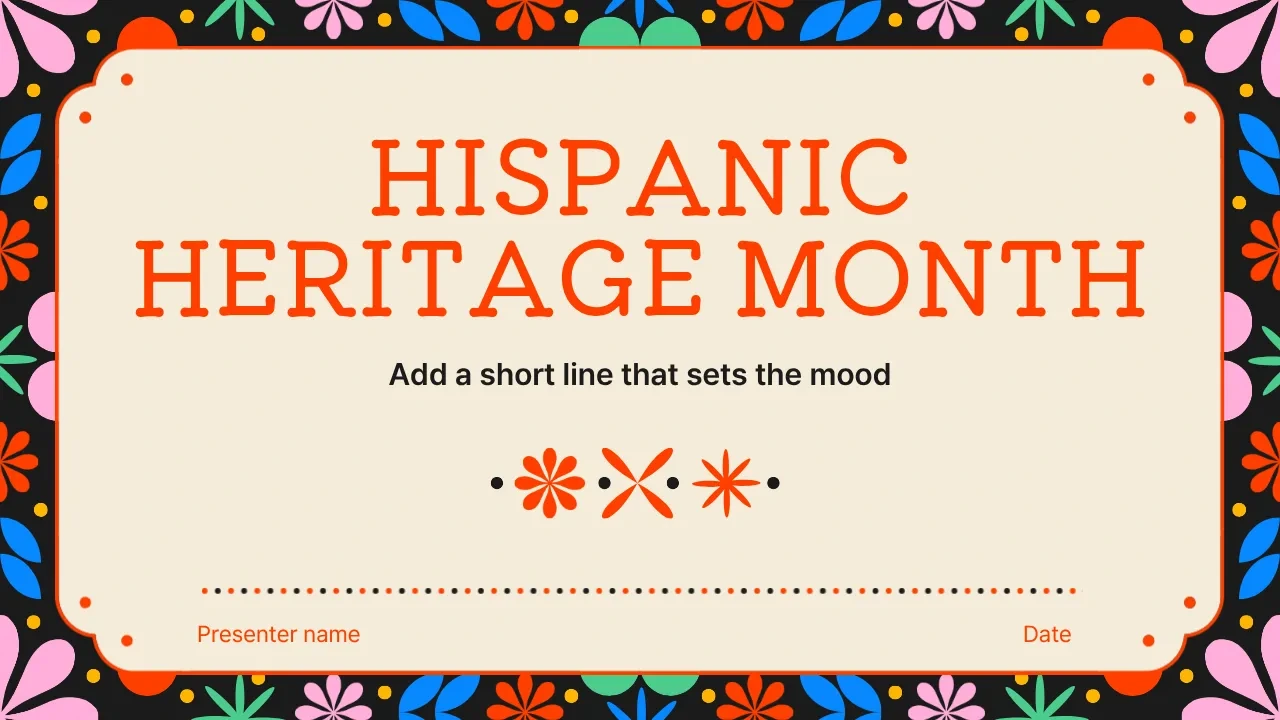
A final "Thank you" slide signals that the lesson is over. A final activity gives students a reason to continue thinking about what they learned.
End the presentation with one clear next step. Depending on the class and grade level, students could:
Add a deadline or clear instruction so the final slide functions as an assignment rather than a general suggestion.
The Colorful Traditional Hispanic Heritage template provides a bold frame that can be adapted for one focused instruction or discussion question.
The five-slide sequence can work across grade levels. What changes is the amount of information on each slide and the activity students complete afterward.
Use one large image and one or two short facts per slide. Introduce one country or community at a time, and reduce the influential-person slide to a photograph and one memorable fact.
For the final activity, students might draw a picture, create a mini-poster, read a short biography, or share one new thing they learned.
The five-slide structure can be used as written. Include a few supporting facts on each slide and end with a short research, writing, or group discussion activity.
Students could also create an additional country or influential-person slide using the same structure.
Spend less time explaining the basic format of the observance and more time examining history, identity, representation, and cultural context.
Students can also explore how terms such as Hispanic, Latino/a, Latine, and Latinx differ, and why individuals and communities may prefer different terms for themselves.
For the final activity, ask students to compare sources, research a local community, analyze representation in media, or create a presentation supported by citations.
Browse the Hispanic Heritage Month template collection and select a design that suits your students’ age group and the amount of information you plan to include.
The same Hispanic Heritage Month content may need to appear in several places: on a classroom projector, in a printed handout, on a bulletin board, or in a post shared with students and families.
Start with a 16:9 presentation layout because it is the standard format for most classroom screens and projectors. After completing the presentation, you can adapt the same content into other formats, such as:
When changing the aspect ratio, review the placement and readability of each element. A layout designed for a widescreen presentation may need small adjustments before it works as a handout or poster.
MiriCanvas allows you to edit the presentation and create additional visual materials in the same browser-based editor, helping you maintain a consistent design across classroom formats.
Hispanic Heritage Month begins on September 15. Using a five-slide structure can make the lesson easier to organize while still giving students meaningful historical and cultural context.
Begin with the dates, focus on one country or community, introduce an influential person, explore a cultural tradition with context, and finish with an activity students can complete.
Every classroom is different, so choose examples that connect with your students, curriculum, and local community. You can also duplicate individual slides when a topic deserves more time or when students want to explore additional countries and people.
Start with the Hispanic Heritage Month template collection and customize the design for your lesson in MiriCanvas.
National Hispanic Heritage Month takes place from September 15 to October 15, 2026.
It begins on September 15 because that date marks the anniversary of independence for Costa Rica, El Salvador, Guatemala, Honduras, and Nicaragua. Mexico celebrates its independence on September 16, Chile on September 18, and Belize on September 21.
The observance began as Hispanic Heritage Week in 1968 and was expanded to a month-long period in 1988.
A short classroom presentation can include five slides:
1. The dates and purpose of Hispanic Heritage Month
2. One country or community
3. One influential person
4. One cultural tradition presented with historical context
5. One discussion question, assignment, or student activity
If you want to introduce more countries, people, or cultural examples, duplicate the relevant slide and expand the presentation.
The appropriate length depends on the students’ grade level and the purpose of the lesson. A five-slide presentation can support a short classroom introduction, while a longer lesson may include additional country profiles, biographies, discussion questions, and activities.
Keep the text concise enough for students to read from the classroom screen. Additional details can be shared verbally or included in a separate handout.
Yes. The five-slide structure is based on the content of the lesson, so it can be used in PowerPoint, Google Slides, Keynote, MiriCanvas, or another presentation program.
A 16:9 layout is recommended because it fits most modern classroom screens and projectors.
Use less text, larger images, and one central idea per slide. Focus on one country, one person, and one cultural example rather than introducing too many names and facts at once.
For the final activity, ask students to draw, write, read, discuss, or create something based on what they learned
Yes. The templates linked in this article can be opened and customized in the browser-based MiriCanvas editor. You can replace the text, change images and colors, rearrange elements, and adapt the design to your students and lesson objectives.
Pick a free template, edit the text and images, and you’re done in minutes.
Browse templates